How to Get 5-Star Google Reviews on Purpose Instead of by Accident
(Why good businesses stay invisible, the five step system that fixes it, and the one sentence that makes asking stop feeling awkward)
AI Marketing Systems Strategist
A couple of summers ago we took the family to Myrtle Beach and ended up at one of those all you can eat crab buffets. Paper on the tables, mallets, bibs, the whole thing.
Our waiter was a kid, maybe nineteen, running the entire section on his own. He was genuinely good at it. He kept up, he was funny with the kids, he noticed my mother in law needed a smaller plate before she asked for one.
At the end, he did something most people in his job never do. He asked.
Something like: "If you had a good time tonight, would you mind leaving us a Google review?"
And then nothing happened. Not because we did not want to. Because there was nothing for anything to happen with. No card. No QR code on the check. No link in a text. Just a sentence, floating in the air, aimed at six people covered in crab and looking for their shoes.
He did the hardest part of the job. He asked. And then the system behind him handed him nothing to ask with.
I meant to leave that review. I write about this for a living and I did not leave that review. By the time we were in the car, somebody needed the bathroom and somebody else had sand in places sand should not be, and the moment was gone.
That is the whole problem in one sentence. The reviews you are missing are not missing because people were unhappy. They are missing because being happy is not enough to carry a person through eight steps on a phone in a parking lot.
So this is a walkthrough of how to fix that. Not how to be a better business, you may already be the best one in town. How to stop losing the credit for it.
Part 1Why the reviews you earned never get written
Most owners I talk to have quietly decided that reviews are a popularity contest they are losing. The competitor down the road has 84 reviews and a 4.7, they have 11 reviews and a 4.9, and the conclusion they draw is that something about the other business must be better.
Almost never true. The other business has a system. That is the entire difference, and it is a much smaller difference than it looks.
Count the steps you are actually asking for
Here is what a happy customer has to do when you say "leave us a review" and hand them nothing.
- Remember, later, that they meant to.
- Unlock the phone.
- Open Google or Maps.
- Type your business name, correctly, from memory.
- Pick the right listing out of several, including the two that are not you.
- Scroll down past the photos and the hours and the questions.
- Find the write a review button, which moves around.
- Pick a star rating.
- Think of something to say.
- Type it on a phone keyboard.
- Post it.
Eleven steps, and step one is the killer, because step one happens at home, on the couch, with no reminder of you anywhere in the room.
Now think about who clears an eleven step wall without help. Somebody with momentum. Somebody with a reason to push through friction.
That is the part that should worry you. Anger is momentum. Being mildly, pleasantly satisfied is not. So the people who climb the wall unassisted skew toward the ones who have something to get off their chest, and your rating ends up being written by your worst nights instead of your average ones.
You are not being punished for bad service. You are being scored by a self selecting sample.
The three things people try first, and why they stall
Before we build the fix, it is worth naming the three attempts I see most, because you may already be making one of them and wondering why it is not working.
The biggest myth about Google reviews
The myth is that reviews are a reward for being good, and that a business which deserves them will accumulate them.
Being good produces the feeling. That is genuinely the hard part and if you do not have it, nothing below will help you, and you should go fix that first.
But a review requires three things in the same moment: the feeling, a link, and a reason to act now. Most good businesses reliably produce one of the three and leave the other two to chance.
So the goal is not to be more deserving. The goal is to be present at the moment the feeling exists, with the link already in the person's hand.
Part 2The sixteen things reviews actually do

I want to go through this properly, because "reviews are important" is the kind of advice that is true and completely useless. Here is what a steady stream of them actually changes, grouped by the job it does.
One honest note before the list. You will find articles with precise percentages attached to every one of these. I have left the numbers out, because when I went looking for solid sourcing on the ones that get quoted most, I could not find it. The mechanisms below are real and you can watch them work in your own account. The decimal points you see elsewhere are mostly copied from each other.
What reviews do for how often you get found
-
You surface for "near me" instead of your own name
Anyone searching your business by name already knows you exist. The money is in the people typing "best barber near me" or "emergency plumber open now," and review quantity and rating are part of how Google decides who to put in front of them. Being invisible to that search is the most expensive thing on this list.
-
Every review is a page update you did not have to write
A profile with something new on it every week behaves differently from one that has been static since 2022. You are publishing fresh content about your business without opening a laptop, and somebody else is doing the writing.
-
Your customers describe you in words you would never use
This one is undersold. You call it "residential HVAC maintenance." Your customer writes "came out the same day when our air went out in July." That second phrase is how actual humans search. Reviews fill your profile with the vocabulary of the people looking for you, for free, and no amount of sitting in a room guessing at keywords gets you there.
-
A recent review proves you are still open
Put yourself on the other side of it. You find a business with eleven reviews and the newest one is from two years ago. What do you assume? Not that they are bad. That they might not be there anymore. Recency does not just help you look good, it answers a question the customer did not know they were asking.
What reviews do for whether somebody picks you
-
Strangers vouch for you better than you can
You can say you are reliable. It is the weakest possible form of the claim, because of course you say that. Fifty strangers saying it, unprompted, in their own clumsy words, does something your own website physically cannot do.
-
The gap becomes a moat
If you have 200 reviews and your nearest competitor has 30, that is not a lead they close in a quarter. It took you years of small moments and it will take them years of small moments. Of all the advantages a local business can build, this is one of the most annoying to catch up to.
-
People who are new here have nothing else to go on
Someone who just moved to town, or who is here on vacation, has no neighbor to ask. Your reviews are the only reputation you have with them. For anywhere with tourists, students, or new builds going up, this is a bigger share of your customers than it feels like.
-
Reviews travel further than the review
People screenshot them. People text them to their sister. "Look at this guy's reviews" is a real sentence that gets said in real kitchens. A review is a piece of word of mouth that keeps working after the conversation ends.
-
They compound, which advertising does not
When you stop paying for ads, the ads stop. The review you earned in March is still sitting there in November doing the same work, and it did not send you an invoice. It is one of the only marketing assets a small business owns outright.
What reviews do for everything else you are already paying for
-
A billboard you do not rent
Your profile is visible on the single most used map in the world, around the clock, with no monthly spend. The rating sitting next to your name is the headline on it, and you are either writing that headline deliberately or leaving it to whoever is annoyed enough to type.
-
Every other channel starts converting better
This is the one owners discover by accident. You run ads, and people who click your ad go and check your reviews before they call. Same budget, same ad, better numbers, because the thing people do between seeing you and contacting you got stronger. Reviews do not replace your other marketing, they raise the ceiling on it.
-
Social content you did not have to think up
A good review, pulled onto a plain background, is a post. That is the whole job. It is specific, it is credible, somebody else wrote it, and it solves the problem of staring at an empty content calendar on a Sunday night.
-
Replying in public shows how you handle problems
Your replies are read far more than you think, and mostly by people who have not bought from you yet. A calm, human answer to a two star review is more persuasive than ten five star reviews, because it is the only evidence available of what you are like on a bad day.
-
A focus group that costs nothing
Three people mention parking. Four people mention the same employee by name. That is market research you did not commission, delivered in the customer's own words. Most owners read reviews for the rating and miss the fact that they are being told exactly what to fix.
-
Your own website gets more persuasive
Pull real reviews onto your site, near the point where someone decides to call, and the page stops being a brochure and starts being evidence. Same traffic, same page, a visitor who now has a reason to believe you.
-
Good people want to work somewhere well reviewed
Candidates look you up. So do suppliers, and landlords, and the larger company deciding whether to subcontract to you. A strong profile quietly recruits on your behalf while you are doing something else, which is the sort of benefit nobody plans for and everybody notices once they have it.
Sixteen reasons, and they all depend on the same thing: a reliable way to turn a good moment into a posted review. So let us build one.
Part 3The five step review system
What follows is the whole method. Nothing is held back and nothing in it requires buying anything from me. Budget an afternoon for the setup, and about three seconds per customer forever after.
The shape of it is simple. Get the real link, put it on something physical, attach it to a moment that already happens, give your people the words, then put the link everywhere the physical thing is not.
Step 1Get your actual Google review link
Fixes the single most common mistake in Part 1
Do this. Get the URL that opens the star rating box directly. Not your Maps listing. Not your website. The review form.
Why it matters. This link is the whole system. Everything else in this tutorial is a delivery mechanism for it. Get this wrong and you will print a hundred cards that send people somewhere they then have to navigate out of, and you will not find out, because nobody tells you.
How, the official way. Sign in to your Google Business Profile and look for the card labeled Ask for reviews, which on the mobile app has sometimes been labeled Share review form instead. It gives you a short link and a copy button. Google moves these labels around more than you would like, so if yours looks different, do not panic, you are looking for any button whose job is to hand you a review link.
How, the fallback that always works. If the card is missing, or your profile is not verified, or you manage a business you do not own, use the Place ID. Open Google's Place ID Finder, search for the business, and copy the ID it gives you. It looks like a long string beginning with Ch. Then build this URL:
https://search.google.com/local/writereview?placeid=YOUR_PLACE_ID
Paste your ID in place of the last part. That is it. This format has worked for years and does not depend on which buttons Google is showing you this month.
Your output. One URL, saved somewhere you can find it in six months.
Check. Open it on your phone in a private browsing window. You should land on a box with five stars waiting to be tapped. If you land on your business listing instead, you have the share link, not the review link. Go back and get the right one.
If you would rather not do any of the above, the free tool at the end of this post does this step for you in about a minute, including for service area businesses that do not show a public street address. But do read the check above either way, because it is the test that tells you your link is real.
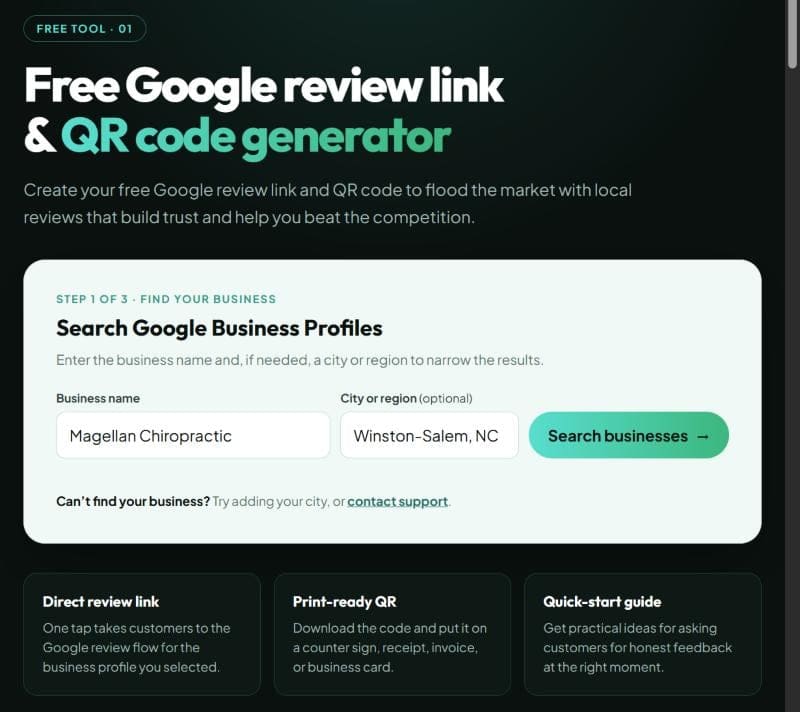
Step 2Put the link on something you can hand to a person
Turns an eleven step request into one scan
Do this. Turn the link into a QR code and print it on a business card.
Why it matters. A link you have to say out loud is not a link. The physical card is what lets the ask happen at the exact moment the feeling exists, which is the whole thesis of this post. It also gives the person something to put in their pocket, which means the moment survives the walk to the car in a way my crab buffet waiter's did not.
How. Open Canva and choose the blank business card template.
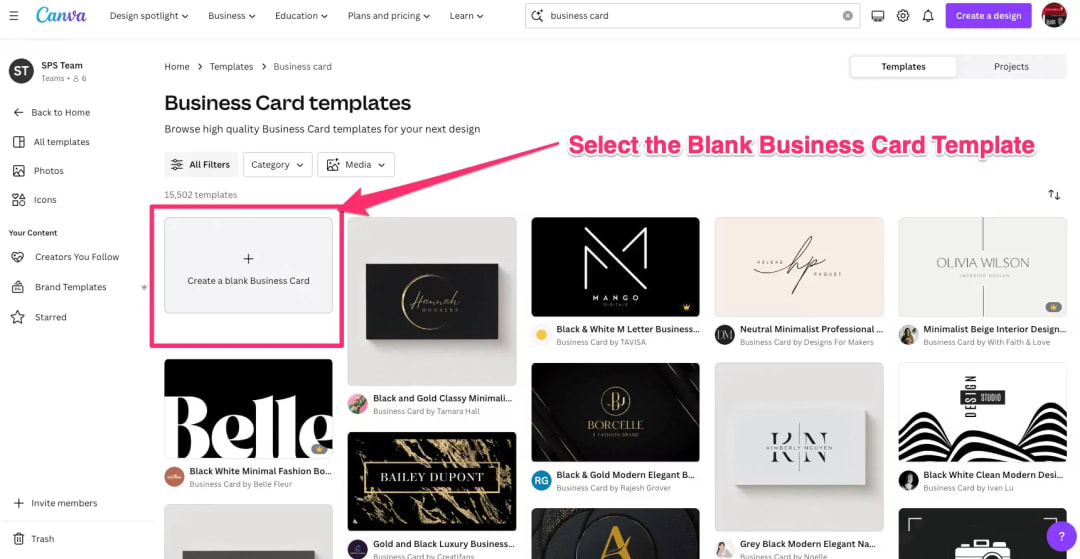
If you already downloaded a QR image in step one, drop it straight on. Otherwise search the Apps panel inside Canva for the QR code app, paste your review link into the URL field, and it generates one for you. Then put four things on the card and nothing else:
- The QR code, large. At least three quarters of an inch square, with pale space around it.
- Your business name or logo, so it is obvious who the card is from.
- A line of instruction. Scan to leave us a Google review works. Say the word Google, people trust the word Google.
- Nothing else. No phone number, no address, no hours. Every extra thing on the card is a thing that competes with the one action you want.
Then use the Share button at the top to have Canva print them and mail them to you. Order at least 100. They are cheap enough that running out is the only real mistake available to you here.
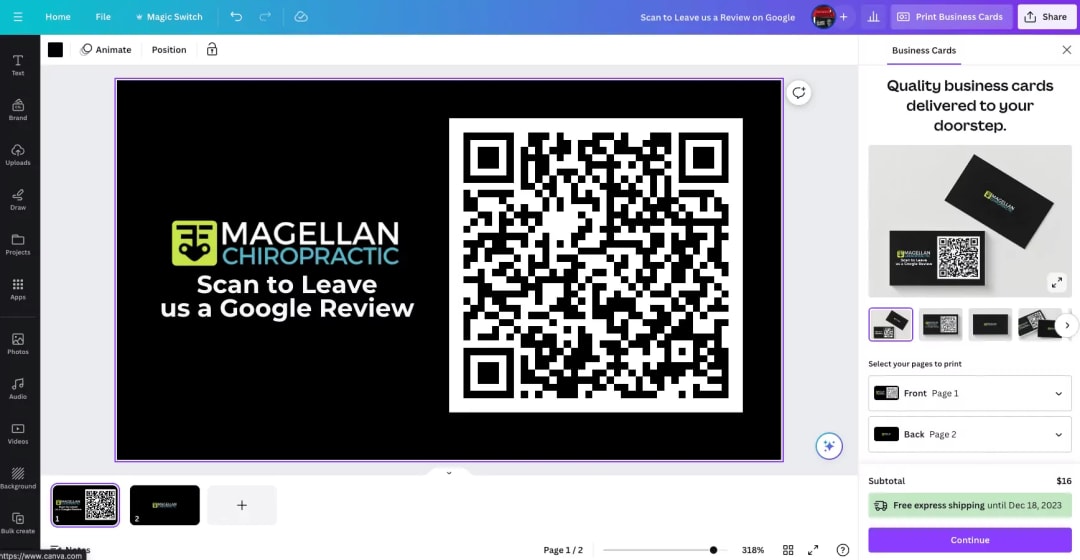
Your output. A box of cards, and the Canva file saved so you can reprint without rebuilding.
Check. Before you order a hundred, print one on your home printer and scan it with the native camera app on both an iPhone and an Android, from about a foot away, in bad light. If anyone has to move the phone around to get it to catch, make the code bigger.
Step 3Attach the ask to a moment that already happens
The step that decides whether any of this survives week two
Do this. Name one specific, repeatable moment in your existing process where the card gets handed over. Write it down. One moment, not a policy.
Why it matters. This is where review systems die, and it is the step that most walkthroughs skip entirely. "Hand out cards" is not an instruction, it is a hope. It survives about nine days. "The card goes in the folder with the invoice, every time" is an instruction, because it attaches to something that was going to happen anyway and fails loudly when it does not.
How. Look for a moment that is already part of the job, that happens near the end, and where the customer is not in a hurry. Some that work:
- Restaurant or bar. The card goes down with the check, not after payment. They are sitting still and they are about to be pleased with you.
- Trades and home services. The card gets handed over at the walkthrough, when you show them the finished work. That is the peak, and it is before the invoice, which is the trough.
- Clinic, salon, studio. At the front desk while they rebook. They are already standing there with a phone out.
- Retail. In the bag, every bag, plus one by the register.
- Anything delivered or shipped. In the box, on top, facing up.
Pick the moment where somebody has just said thank you and meant it. That sentence is the trigger. If you are not sure where it is in your process, pay attention for two days and you will hear it.
Your output. One sentence on paper: "The card goes out at ______, every time."
Check. Count how many times that moment happened last week. If the answer is fewer than ten, you picked a moment that is too rare, and you need a different one or a second one.
Step 4Give your people the sentence
Where most of the awkwardness actually lives
Do this. Write the exact words that get said when the card changes hands, and teach them to everyone who will say them.
Why it matters. Your staff are not avoiding this because they are lazy. They are avoiding it because asking a stranger for a favor feels like begging, and nobody has given them a script that does not feel that way. Hand them one and the resistance mostly evaporates.
How. Here is the line I give people, and the reasoning matters more than the words.
"How did I do tonight? If I did alright, would you leave a quick bit of feedback? There's a code on the card. And if you felt like mentioning me by name, that'd make my week."
Three deliberate things in there.
It asks for feedback, not a review. This is the single most useful change you can make and it costs nothing. "Leave us a review" sounds like a marketing task you are assigning. "Tell me how I did" sounds like a person who cares what the answer is. Same destination, completely different thing to be asked.
It gives the staff member a personal stake. "Mention me by name" turns a company errand into something that is theirs. People ask for things they benefit from. They also, usefully, produce much better reviews, because a review that names a person is specific, and specific reviews are the persuasive ones.
It is slightly apologetic and gives an easy out. "If I did alright" lets anyone who was not thrilled decline without a scene, which is both kinder and smarter. You do not want the reluctant ones.
One more thing on the feedback framing, because it matters legally and ethically. You are asking everyone, not just the happy ones, and you are not offering anything in exchange. Do not screen people, do not route unhappy customers to a private form while sending happy ones to Google, and do not offer a discount for a review. Every platform treats that as gaming the system, and they are right.
Your output. The sentence, written on an index card taped where your people will see it before a shift.
Check. Say it out loud to someone who does not work with you. If it sounds like a sales line, cut words until it does not.
Step 5Put the link everywhere the card is not, and answer every review
Where the slow compounding happens
Do this. Place the same link in every digital spot where you already touch a customer, then commit to replying to every review you get.
Why it matters. The card catches people who are standing in front of you. Plenty of your best customers are not, and the link costs nothing to add once you have it. The replying half is separate and arguably more important: replies are read by future customers, and they are the only public evidence of how you behave when something goes wrong.
How. Add the link to these, which takes about twenty minutes in total:
- Your email signature, as a short line rather than a raw URL.
- The footer of your invoices and receipts.
- Your thank you text or confirmation message, if you send one.
- A small sign by the register or in the waiting area, same QR code.
- Your website, somewhere near where people decide to contact you.
Then set a recurring fifteen minutes, once a week, to reply to everything new. Thank the good ones briefly and by name. For the bad ones: acknowledge the specific thing, do not argue the facts in public, say what you will do, and offer to take it offline. Write it for the stranger reading it in six months, not for the person who wrote it.
Your output. Five placements live, and a standing slot in your calendar.
Check. Write down your review count and your rating today, with the date. Look again in thirty days. That number is the only honest scoreboard here, and almost nobody writes down the starting figure, which is why almost nobody can tell whether any of this worked.
Part 4Your first week, and the shortcut
If you are doing this yourself, here is what a realistic week looks like. The waiting is the longest part, and it is shipping, not work.
- Day one, fifteen minutes. Get your review link and run the private window check on it.
- Day one, thirty minutes. Build the card in Canva and order at least 100. Do this the same day, while you still have the link open.
- Day two, ten minutes. Name the moment. Write the sentence. Both on paper.
- Day two, twenty minutes. Add the link to your signature, invoices, texts and website. This part works immediately and does not wait on the mail.
- Day three. Write today's review count and rating on the same piece of paper as the sentence.
- When the cards arrive. Scan one. Then hand them out, starting with the moment you named.
None of that is hard. All of it is genuinely doable on your own, and if you stop reading here and go do it, I will be pleased rather than disappointed.
Here is my sincere recommendation and request
I will tell you where it actually stalls, because I have watched it stall plenty of times, and it is not where people expect.
It is step one. Not because it is hard, but because it is boring and fiddly and sits right at the front, which is the worst possible place for a boring fiddly thing to sit. The Ask for reviews card is not where the article said it would be. The profile is not verified. The business is a service area business with no public street address, so the normal route does not work. Somebody finds a Place ID for the wrong location. And the whole project, which was going to take an afternoon, becomes a tab left open for three weeks.
So I built the thing that removes that step, and I give it away, because a review link is not something anyone should be selling you.
The free Google review link and QR code generator
Search your business, get back the two things you need to start.
- Your direct review link, the one that opens the star picker rather than your listing.
- A print ready QR code you can download as a PNG and drop straight into the Canva card in step two.
- Service area businesses included. The search covers profiles that do not show a public street address, which is the case the manual method handles worst.
- A quick start guide by email, plus three printable review capture tools you can edit in Canva.
Free, and no credit card. It asks for your name and email so it can send the guide and the tools. Adding your cell number is optional and gets you text support while you set it up.
Get your free review link and QR code
This is my own tool, so take the recommendation with that in mind. Everything in Part 3 is the real method and the Place ID route above works perfectly well without me. I would genuinely rather you had a working review link you made yourself than a tab you never came back to.
One last thought about that waiter.
He is the reason I care about this. He did everything right and the business he worked for had not spent twenty minutes giving him anything to hand me. Somewhere in that restaurant was a manager wondering why the reviews were thin, with no idea that their best employee was asking for them nightly and getting nothing, because asking was the only part anybody had thought about.
Twenty minutes. That is the whole gap.
If you set this up, send me the link to your card. I would like to see it.